School Nursery vs Independent Nursery: Which Choice is Right for Your Child?
The early years spanning from birth to age five lay the cognitive, social, and emotional foundations for everything that follows. In the UK, parents typically weigh up two main options for early education: a school-based nursery (attached to a primary school) or an independent day nursery.
While both options follow the Early Years Foundation Stage (EYFS) framework set by the Department for Education, the daily experience, flexibility, staffing structures, and environment differ considerably. Understanding these differences allows you to choose the setting that best aligns with your child’s personality and your family’s daily routines.
Understanding the Fundamentals
Before diving into the finer details, it is helpful to clarify what each setting actually offers.
What is a School Nursery?
A school nursery (often called a maintained nursery class) is integrated directly into a state or private primary school. These settings typically cater to children aged 3 to 4 in the academic year before they enter Reception. They operate strictly during school term times and closely mirror primary school schedules, operating between 8:30 am and 3:30 pm.
What is an Independent Day Nursery?
An independent day nursery such as Jellybeans Childcare is a standalone early years setting designed specifically for babies and young children, usually from 3 months up to 5 years old. Independent nurseries operate year-round (typically 50 to 52 weeks a year) with extended opening hours, often from 7:30 am to 6:00 pm, to accommodate the realities of working parents.
Key Comparison Areas Every Parent Must Consider
1. Hours, Operations, and Year-Round Flexibility
One of the most practical differences between the two settings comes down to logistics.
- School Nurseries: Run on traditional term times (around 38 weeks a year). Their sessions are usually split into morning or afternoon half-days (e.g., 9:00 am – 12:00 pm or 12:30 pm – 3:30 pm), or standard school hours. If you work full-time, managing the school holidays and 3:30 pm finish times often requires arranging additional wraparound care, childminders, or holiday clubs.
- Independent Day Nurseries: Built around contemporary family life. Operating continuously throughout the year (excluding bank holidays), independent nurseries provide full-day care from early morning to early evening. This consistency ensures your child benefits from a stable daily routine without the disruption of frequent term breaks.
2. Age Ranges and Developmental Continuity
How long a child can stay in one setting plays a crucial role in their emotional security.
- School Nurseries: Children generally join at age 3. If your child has not attended childcare before, starting at age 3 in a larger school environment can sometimes feel like a steep transition.
- Independent Nurseries: Care begins in infancy (3 to 6 months) and continues through to school age. This multi-year journey allows practitioners to build deep, trusting relationships with your child over several years. Children move smoothly through specialised rooms tailored to their developmental milestones from baby rooms focused on sensory exploration to pre-school rooms focused on independence and school readiness.
3. Staffing Ratios and Individual Attention
Staff-to-child ratios directly influence how much individualised support your child receives throughout the day.
- School Nursery Ratios: Under UK statutory guidelines, school nursery classes operating under Qualified Teacher Status (QTS) can have a ratio of 1 adult to 13 children for 3- and 4-year-olds. While teachers bring strong pedagogical expertise, class sizes can reach up to 26 or 30 children with only two adults in the room.
- Independent Nursery Ratios: Independent settings strictly adhere to tighter early years ratios:
- Under 2s: 1 adult to 3 children
- 2 to 3 years: 1 adult to 4 or 5 children
- 3 to 5 years: 1 adult to 8 children
With smaller key groups, independent nursery practitioners can offer higher levels of individual nurture, tailor activities to specific interests, and provide immediate emotional reassurance whenever needed.
4. Curriculum Delivery and Learning Environments
Both settings deliver the statutory EYFS curriculum, covering key learning areas such as Communication and Language, Personal, Social and Emotional Development (PSED), and Physical Development. However, the style of delivery often differs.
- School Nurseries: Learning environments tend to be more structured and classroom-orientated. Children are introduced early to school assemblies, dining halls, and larger playground areas, which can be advantageous for children who thrive in larger group environments.
- Independent Nurseries: Emphasise child-led, interest-based learning through rich play experiences. Environments are designed to feel warm, homelike, and welcoming rather than institutional. Children learn through hands-on exploration, outdoor play, and tailored activity stations that build confidence at their own pace.
Summary: School Nursery vs Independent Nursery
To help clarify how these options compare side by side, review the key operational and educational differences below:
| Feature | School-Based Nursery | Independent Day Nursery (e.g. Jellybeans Childcare) |
| Age Range | 3 to 4 years old | 3 months to 5 years old |
| Operating Hours | 8:30 am – 3:30 pm (Term-time only, 38 weeks/yr) | 7:30 am – 6:00 pm (Year-round, 50–52 weeks/yr) |
| Staff Ratios (Ages 3–4) | 1:13 (with QTS practitioner) | 1:8 (ensuring higher individual focus) |
| Environment | Primary school setting, larger group sizes | Nurturing, home-from-home, purpose-built early years rooms |
| Flexibility | Set half-day or school-day sessions | Full days, part-time blocks, flexible working alignment |
| Funding Accepted | 15 & 30 Hours Free Entitlement | 15 & 30 Hours Free Entitlement + Tax-Free Childcare |
| Meals & Care | Packed lunches or school dinners | Freshly prepared hot meals, snacks, and full dietary care included |
Weighing Up the Pros and Cons
School Nursery: Advantages & Considerations
Pros:
- Early familiarisation with a primary school site, staff, and routine (if your child continues at the same school for Reception).
- Direct oversight by qualified primary school teachers.
- Convenient if you already have older siblings attending the primary school.
Considerations:
- Standard school hours rarely cover a full working day without extra wraparound care.
- Term-time closures require alternative care for up to 14 weeks every year.
- Higher adult-to-child ratios mean less one-to-one time during crucial developmental years.
- Attendance at a school nursery does not guarantee a place in that school’s Reception class under local authority admissions rules.
Independent Nursery: Advantages & Considerations
Pros:
- Unmatched flexibility with long opening hours and 52-week availability.
- Lower staff-to-child ratios foster stronger key-person relationships and tailored care.
- Holistic development from babyhood through to pre-school, reducing stressful educational transitions.
- Balanced preparation for school that builds independence, self-care skills, and social confidence without rushing formal classroom mechanics.
Considerations:
- Children will transition to a new school building when starting Reception (though high-quality nurseries run dedicated pre-school transition programmes to make this smooth and exciting).
How to Decide: Questions to Ask Yourself
When evaluating options, consider these practical questions to determine which environment best suits your family:
- What are your family’s working hours? Do you need reliable year-round care from 8:00 am to 6:00 pm, or can your schedule accommodate school hours and 14 weeks of holidays?
- What is your child’s temperament? Does your child thrive in intimate, smaller group settings with high adult interaction, or are they comfortable in busier school halls and larger groups?
- How old is your child? If your child is under three, an independent nursery provides seamless continuity that carries them all the way through to primary school without needing to change settings at age three.
- Is school readiness a priority? Independent nurseries place a strong focus on self-regulation, curiosity, literacy, and numeracy foundations through play ensuring children are socially and emotionally prepared for any primary school they enter.
Why Independent Care at Jellybeans Childcare Offers the Complete Package
At Jellybeans Childcare, we believe that early childhood education should give children the best possible start in life while offering parents complete peace of mind.
Our independent nurseries combine the academic benefits of the Early Years Foundation Stage (EYFS) curriculum with the warmth, flexibility, and individual care that every young child needs to flourish.
What Sets Our Early Years Provision Apart?
- Dedicated Pre-School Classrooms: Our pre-school rooms are specifically curated to bridge the gap between nursery and primary school, incorporating phonics, early mathematics, self-dressing, and social independence.
- Year-Round Reliability: We are open 52 weeks a year, providing a consistent routine for your child and dependable support for working parents.
- Government Funding Support: We fully support government childcare funding schemes, including 15 and 30 hours funded childcare for eligible working families, as well as Tax-Free Childcare.
- Nutritious Meals: Balanced, delicious meals and healthy snacks are cooked fresh daily to fuel your child’s active day.
What the little ones have been up to: Exploring Coral Reefs!
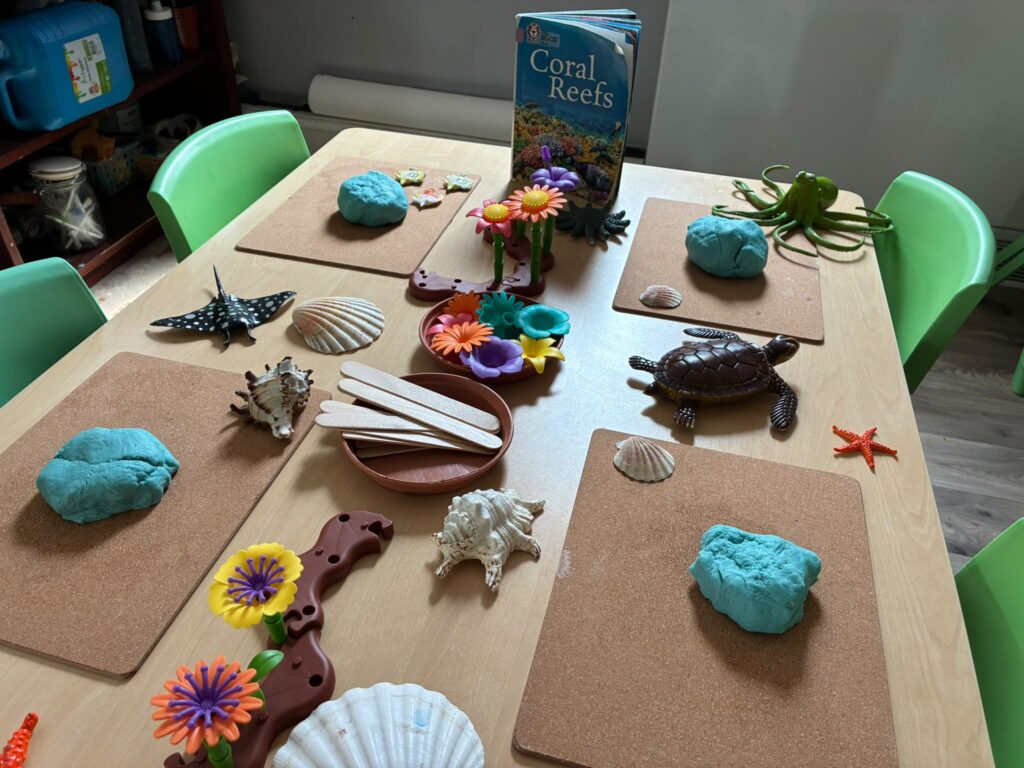
This week, our little explorers dived deep into an ocean-themed sensory adventure, using turquoise play dough, real seashells, toy sea creatures, and plastic corals at their play stations to bring the colourful world of our “Coral Reefs” book to life!
Take the Next Step for Your Child’s Early Education
Choosing between a school nursery and an independent nursery comes down to finding the environment where your child will feel safe, valued, and inspired to learn. Nothing compares to experiencing a setting firsthand.
We warmly invite you to visit your local Jellybeans Childcare centre, meet our passionate team of educators, and explore our engaging learning environments.
Ready to find out more or arrange a visit?
Contact us today to book a personal tour and discover how we can support your child’s early educational journey.


Contact
By phone:
By email:
Social media:
Schedule a Visit
Fancy popping to have a look at the Jelly Beans Day Nursery in person? Talk to us to arrange a visit now.
Schedule a VisitVirtual Tour
Have a look at our Nursery from wherever you are right now via our Virtual Tour video.
Virtual Tour
